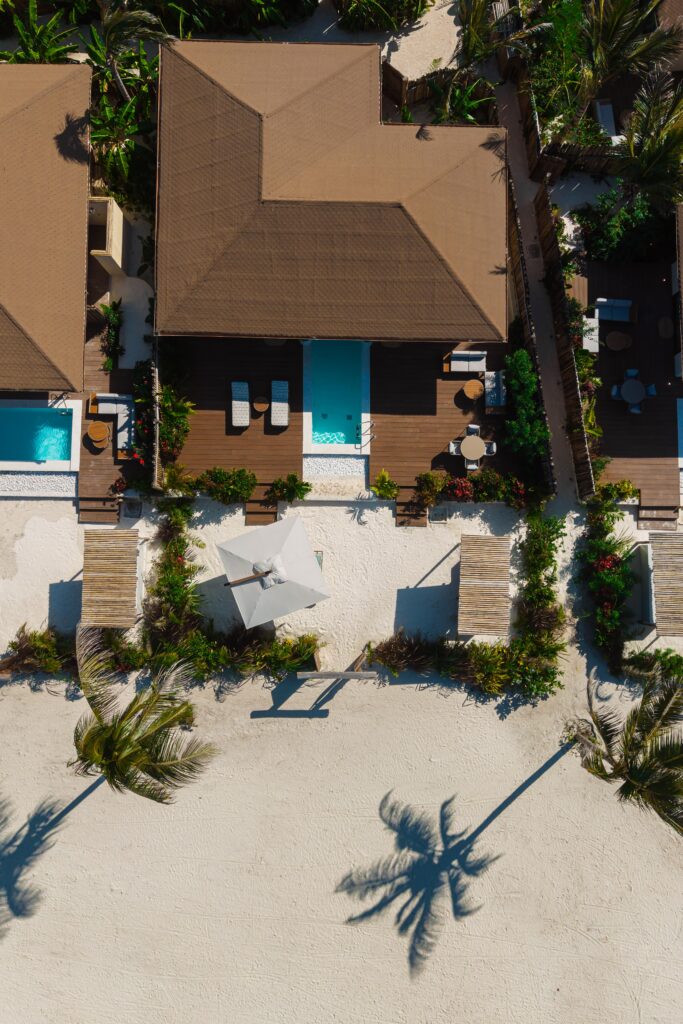
Keemala opened four years ago and thanks to its stunning architecture, has become one of the world’s most recognisable and Instagrammable eco-resorts. But given its location on Phuket, which is tackling issues of over-tourism and its relatively small size, just how eco-friendly can Keemala be? Steph Curtis-Raleigh went to find out.
After the many hours in the air, the steamy air of a Phuket evening wraps around us as we scan the crowds for our airport transfer. The 40-minute journey that follows is full of jostling traffic and bustling neon-lit towns, until suddenly we pull off the main road, climb a steep hill and pull up at an impressive gate. Above us, incredible woven structures seem to be suspended from the branches of the trees like Christmas baubles.

The welcome at Keemala is warm and gentle, soothing jangled nerves. Garlanded with flowers, we are led along a walkway into a circular inverted wicker dome overlooking the local town and the sea, which issues up a slight breeze as we are served sweet tea and honey cakes. Then we are whisked silently to our villa on the back of an electric golf cart. As we whizz along narrow curving paths flanked on either side by tall greenery, the air is perfumed from arches of night jasmine with a base note of lemongrass, which is the signature scent of Keemala. It’s only 8pm but there are no signs of the other guests, except for the lights from their accommodation.
We are staying on the edge of the resort in a Clay Pool Cottage with 2 bedrooms, a massive indoor/outdoor bathroom/dressing room and a wonderful terrace featuring its own small plunge pool. All 38 villas on the site have their own pools, which means that the main communal pool is never too busy and people have very little inclination to venture out at all.

As well as a main pool with bar, there is a smallish bar and restaurant overlooking the sea and an impressive spa at the resort. Guests often choose to eat in their villas and room service is served until 2am. Each villa features a mini bar where all the soft drinks are complimentary, as are small jars of peanuts and other treats. There are some evening events organised by the management during the week, including an Indian food evening and a barbecue, as well as some welcome drinks.
Keemala isn’t a family resort – it’s really designed for couples and honeymooners but our 12-year-old son adores everything about it – in particular the excellent wifi – and the privacy of his own room which leads directly into the pool – plus the amazing breakfasts! Kids are welcome but those with younger children will find there is not much to keep them entertained.

Being situated at the edge of the resort means that on one side, we look out onto a forested hillside and on the other we can glimpse a couple of other villas through the foliage. Our cottage is on stilts, so we can sit on our balcony within the canopy of the trees – looking down there is a rope bridge over running water, festooned with flaming torches at night. We can spot our breakfast being carried across this on large trays in the mornings.

The feeling of being completely surrounded by greenery and the sound of running water is incredibly comforting. In addition, there are the ever-changing sounds of the insects, birds and animals rustling among the plants below. On top of the humming and hooting is the unbelievable football rattle of the cicadas. Ten minutes spent listening to this natural orchestra transports me into a state which is akin to intense meditation. If you sit still for long enough, the wildlife may even come to you. I watch entranced as a disturbance in the undergrowth reveals itself to be a type of black squirrel, which climbs a neighbouring tree to look me in the eye.
When we are shown our room, our host warns us about the cicadas and the Muslim call to prayer, which emanates from Kamala, the coastal town below. Personally, we find both to be delightful – the Adhan adding to the exotic sensation of the resort.

Strangely, despite the jungle location and the proliferation of small pools and running water on site, mosquitos don’t prove to be a problem for any of us. We are given natural lemongrass oil to ward them off – as well as mosquito coils for our balcony and the resort uses a twice-weekly humane fogging system to keep them at bay.
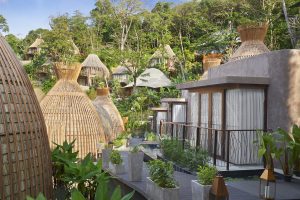
We are offered a complimentary couples spa treatment during our stay and leaving our 12-year-old to the wifi, we walk through the treacle heat to the wicker domes that constitute the spa area. A full body massage for each of us involves some slightly odd disposable net underpants, a foot soak and a choice of scented oils. What follows can only be described as an hour of utter bliss and the best massage of my entire life.

Eating on site or ordering into your villa is perfect for those who want to escape the outside world, however, for us – the option to explore a little is enticing. We take the Keemala courtesy minibus down to Kamala town for a couple of evening meals. The last free bus to town is at 5pm and this means you need to take a taxi back at your own cost, which is not much. Kamala is a typical seaside town, which a stretch of gaudy restaurants vying for the tourist buck lining the beach. Many feature fresh seafood and cheap cocktails – there’s nothing to dislike about the beach or the restaurants but it’s not exactly fine dining.
As for day trips, we resolve to take two during our stay. Keemala has a policy of not allowing any trips to venues that exploit animals. It is easy to comply, as there are a growing number of ethical, well-managed sanctuaries that are available to visit. We went to the Green Elephant Sanctuary Park for an afternoon – guests are allowed either in for a morning or an afternoon visit and this includes a meal. This trip was an absolute highlight of our entire holiday. We fed the elephants, frolicked in a mud bath with them, then washed them clean. We also saw where they were housed at night and were taught about the bond between owner (mahout) and elephant which will last a lifetime and means that the sanctuary houses both together.

Our second trip – booked through our tour operator – for a boat trip to Khao Phing Kan or James Bond Island (it was one of the settings for The Man With the Golden Gun) was more prosaic. While it was wonderful to see the limestone karst towers of the Ao Phang Nga National park off the northeast of Phuket – the island itself was overrun with tourists and the diesel engines of the many pleasure craft escorting them there were a reminder of the problems of over-tourism which has seen nearby Phi Phi Leh island closed indefinitely in 2018.
Keemala is doing a not-insignificant amount to support the sustainability of tourism on Phuket. The resort is lucky in being one of the very few on the island that has its own water supply, which is merely diverted in order to feed the pools and waterfalls. From the start, all disposable plastics were banned from Keemala. In addition, the resort grows over 50% of its own fruit, vegetables and herbs – which are used in the restaurant and spa. A team of 15 gardeners harvest the seasonal fruit from the indigenous trees, including bread fruit, bananas and dragon fruit. We were lucky enough to be offered a tour by one of the head gardeners Mr. Win, who showed us the many trees (some with wonderful names such as Stinky Bean or Stinky Shrimp) and treated us to a demonstration on how rubber is collected.
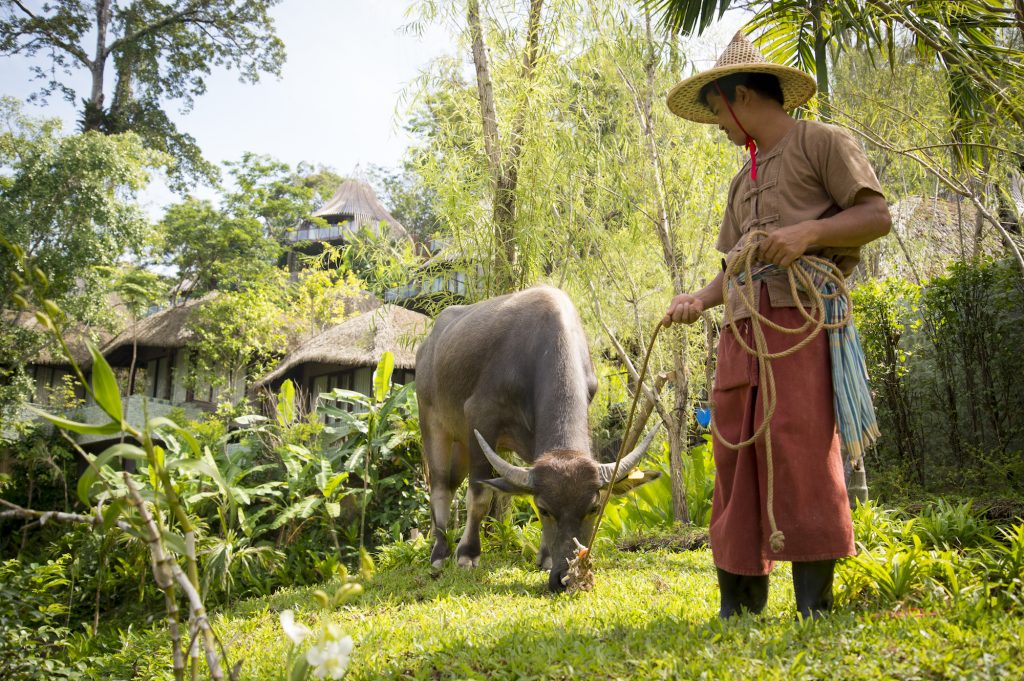
Keemala is working towards zero waste for F&B and has a waste collaboration with a local Scholars of Sustenance programme in order to distribute food to communities in need. Other waste is used in its experimental composting site. Away from the main entrance at the resort, there is a hydroponic mushroom growing hut, as well as a menagerie of rescued animals including, water buffalo, goats and ducks.
On top of that, Keemala is involved in a number of environmental schemes on the island and was the 2019 President of the Kamala Green Club, which organises beach clean ups carried out by hotel staff and guests. The resort has partnered up with a local school/community childcare centre in order to carry out educational and other support. In addition, the team are replanting mangroves as part of a scheme which aims to undo the damage wreaked on the land by industrial shrimp farming, whose chemicals and antibiotics poison the soil to such an extent that it is completely stripped. Following the tsunami of 2004, the community now realises the importance of mangroves in protecting coastal areas. Every 6 months, Keemala is part of a team that plants 600 mangrove trees – with the first shrimp farm completely replanted.
While this goes on in the background, guests are mostly only aware of the utter relaxation and privacy that Keemala offers. The guests we glimpsed were mostly young and beautiful, snapping pictures of themselves for social media, sipping drinks at the bar, or working out in the gym. The resort was almost full and yet it didn’t feel that way at all. The entire resort sleeps a maximum of 80 guests and while the initial draw is often the unique architecture of the accommodation, increasingly, repeat visits are booked because of the wellness offer and other attractions.
We brought home a tiny piece of Keemala as they presented us with a typical Thai box of woven reeds containing their specially blended toiletries, on the last night. The scent of lemongrass in these little bottles transports me back to this green haven, evenings spent listening to the sounds of the jungle on our terrace and the slap of the water cascading down the side of the infinity pool as my son jumped in. It was a magical few days of feeding all of our senses and restoring some balance and I would go back in a heartbeat.

Steph visited Keemala with her husband, (Sunday Times journalist Mark Curtis-Raleigh) and son in February 2020, before travel became impossible with the COVID-19 crisis. They booked and paid for our accommodation independently through bestatravel.co.uk and arranged to interview General Manager Jason Allen Villarino and Marketing and Communication Manager Thareeya Deasakorn Khamkar (My) pictured during their stay.
Keemala is an Eco Resort Network member and is part of the World of Glamping Collection.