by Sonu Shivdasani – Founder & CEO, Soneva
Travel and flying are often highlighted as prime examples of human behavior that contribute to Global Warming, and things that needs to change with immediate effect if we are to handover to the next generation a World similar to what we have been able to experience and love in our own lifetimes.
Whilst air travel will account for a bulk of an individual’s own ecological footprint, it today still accounts for about 2% of greenhouse gases. The damage it causes pales when one considers the contribution to global warming of agriculture, especially the beef industry, where the numbers are 10 to 20 times that of air travel.
There are also some examples of tourism over-development, such as the coast of Spain where developers constructed large concrete jungles that today remain ghost towns for most of the year. The local community lost out big time and their overall quality of life deteriorated. For, the developers tended to be foreign, they generally engaged foreigners and the tourists tended to consume packaged products brought in from outside. Wherever local ingredients or resources were consumed, it was at the expense of the local community. So, in general, the profits of the operations were repatriated, salaries were spent back home, and the local community rarely benefitted from this new commerce. They just suffered from the inflationary pressures on certain qualities of life that they had taken for granted such as cheap seaside living, or fish, which they could no longer afford.
PWC have established a measurement index T.I.M.M. (Total Impact Monitoring & Measurement) that they are encouraging Governments to use in order to drive behavioral change that avoids such examples in the future.
Positive Impact of Tourism Post C-19
In spite of the above, I remain a strong advocate of the overall positive impact of travel & tourism and the key role it plays in conservation. Vast tracts of South and East Africa would now be farmland if it were not for the conservation efforts of the many lodges and camps whose tourists indirectly fund these efforts. Five years ago President Bongo of Gabon transferred 11 million hectares of land from timber concessions and mining concessions to a National Park with a view to attracting tourists to visit.
Closer to home, the Government of the Maldives banned the fishing of both sharks and turtles. Part of the Maldives – Baa Atoll, where one of our resorts is located – has become a UNESCO Biosphere. The catalyst for these actions was the calculation that a shark or turtle swimming happily in the ocean was considerably more valuable alive than dead.
It will be vital for travel and tourism to have a net positive contribution to conservation, the environment as well as the community in order for this industry, which has been my life for the last 30 years, to survive in a post COVID-19 era.
We must consider that combined with this new customer sentiment, the pace of innovation is such that the “ecological” solutions will more and more become the most “economic” solutions. So, whereas in the past, a business, in order to survive beyond 5 or 10 years, had a to have a high EVA (Economic Value Add) today, businesses will still need to have a very high EVA but the E in EVA will stand for ecological more so than economic as the two elements will now be tied together at the hip.
Soneva Experience
Let me now share with you our own experiences at Soneva which I hope will reinforce the case for travel & tourism as an overall source of good.
When my wife Eva and I opened our first resort in 1995 we held a firm belief that a company must have a clear purpose beyond just making money. We were also convinced that a successful business is the one that combines apparent contrasts and makes these ‘opposites’ compatible. When this is achieved and it works, it creates an experience that is both unique and accepted, that one immediately develops a very strong level of loyalty from the guest.
While we wanted to create a hideaway that would satisfy our desires for a dream destination for those who liked to travel in luxurious style, we also had this overwhelming desire to protect the environment. The end result was born out of the philosophy of simple sophistication and returning luxuriously to nature, whilst also shouldering the responsibility of being custodians of the beautiful places we operate in.
Today, two decades later we’d like to think that our guiding principle of creating engaging and imaginative SLOWLIFE for our guests, which is our moral as well as our operating compass, has also provided a blueprint for the future of the hospitality industry.
Our vehicle for delivering the SLOW LIFE is our core philosophy of “Intelligent Luxury”.
It is about combining the traditional opposites of sustainability and wellness with luxury. We believe that these things actually complement each other. At the heart of the matter is what true luxury means for our guests today. The definition of luxury is something that is a rarity, but the wealthy of today come from a different context to the wealthy of the past when some of the more traditional luxuries were established. In today’s society, luxury translates into peace, time and space. It is about the sand between the toes and dinner under the canopy of a billion stars, about reconnecting with oneself and the natural environment. For guests who live in a cramped and polluted concrete jungle, true luxury is to eat a freshly picked salad, grown in our organic garden while breathing fresh air and enjoying a beautiful view.
This SLOWLIFE focus has led to levels of guest loyalty and repeat business that far surpass industry norms, and this tells us unequivocally that the values of a company matter to those who consume its products. This is rare in the modern world but Soneva distinguishes itself because combined with the space, privacy and comfort of our villas and rooms, and the intuitive service provided by our hosts, we have also demonstrated how sustainable materials can have a great aesthetic.
Being able to bring out the beauty of nature, whether it is in our design, or the guest experiences that we offer, has set us apart from the competition.
Being sustainable is also part of our DNA and we are always striving to limit the negative environmental impact of our activities – something which is both difficult as well as critical for a company which operates resorts in remote places of pristine natural beauty.
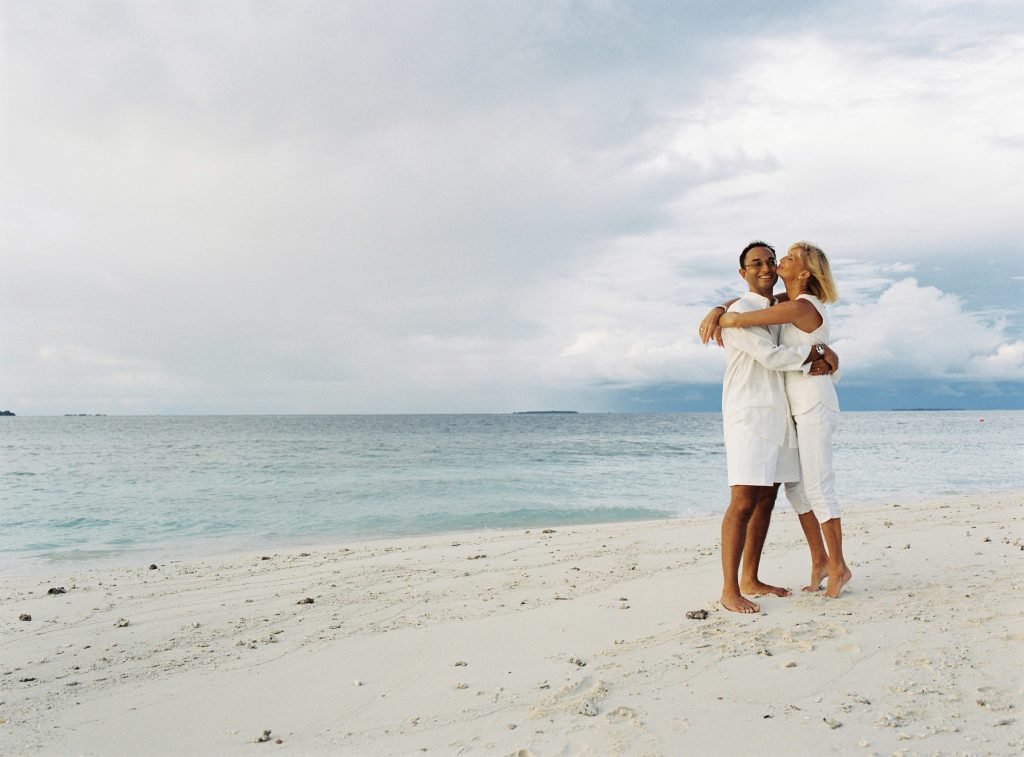
Sonu and Eva Shivdasani by Antonina Gern
Custodians of Community – Soneva Namoona
We may sometimes fall short of our own high standards, but we are very clear about our responsibilities as custodians of the communities we operate in. This responsibility to one’s community is somewhat complicated for a company such as ours whose guests jet in from all over the globe. As a result, our social and environmental responsibilities are as much global as they are local. We therefore set up the Soneva Foundation (a UK registered Charity) to not only focus on local initiatives, but to also focus on change at a level far beyond the direct communities in which our resorts operate and to recognize our obligations to society in general.
One can argue that the Soneva Foundation is exceptional in that nearly all of its’ funding has been derived as a result of changes to the way in which we do business at our resorts, not donations. Let me explain:
Twelve years ago, I noticed a huge number of plastic water bottles washed up on our beaches at Soneva Fushi in the Maldives. We decided not to point fingers at those who were allowing their water bottles to spoil our oceans while still serving bottled water in our resort and therefore still part of the problem. So, we took the decision to stop offering branded bottle water, and instead serve water filtered, mineralised, alkalised, and bottled on site in reusable glass bottles. Today, all the revenues from our water sales go to the Soneva Foundation to fund the work of charities such as Water Charity and Thirst Aid, and more recently, Soneva Namoona.
Soneva Namoona is a partnership between Soneva Fushi, the three nearby Baa Atoll Island communities of Maalhos, Dharavandhoo, and Kihaadhoo, and international NGO Common Seas. The partnership seeks to provide a blueprint for all Maldivian islands on how they can cleanly and effectively manage their waste, reduce the use of single-use plastics, and inspire a love for the natural environment. (Recycle, Reduce, and Inspire)

In the middle of 2019, we installed the first Glass water bottling centre on one of the inhabited island. Traditionally, the water consumed in Restaurants, guest houses and generally by the public on islands is from plastic bottles from the water bottling company in Male, the capital of the Maldives. Soneva Namoona Water filters, and mineralizes the desalinated island water and then places it in sterlized glass water bottles. When the bottles are returned, the user achieves 20% saving on their water purchase compared with if they had bought the water in plastic bottles from Male. So, they are financially better off. As I write, Soneva Namoona water has sold the equivalent of, and avoided 60,000 plastic bottles.
In February 2020, we celebrated a Maldives’ first: Maalhos became the first island in the country to end the practice of burning its garbage in open bonfires. This was made possible by the opening of the island’s Eco Centro waste to wealth centre, funded by Soneva and modelled on Soneva Fushi’s own Eco Centro.
The Maalhos Eco Centro is a waste processing facility that sorts all the waste into different types such as plastic, glass, tin and wood; compacts, crushes, and chips it where possible, and sends it off the island for recycling. Later in 2020, we hope to open Eco Centros on Dharavandhoo, Kihadhoo.
Measuring Emissions Accurately
Let me share with you another example of how we changed the way we do business which generated funding for the Soneva Foundation.
In 2008, we realised that our approach towards measuring carbon emissions was limited as we were only measuring scopes 1 and 2, not scope 3, which covered the externalities i.e. guests flying in, supplies coming into our resorts etc. We thus decided to measure scope 3. To our great surprise, we discovered that 85%, yes, 85% of the CO2 emissions from Soneva Fushi come from scope 3, which the industry in general do not measure.
So, we took the simple step of adding a mandatory 2% Environmental Levy to our guests’ bills, to off-set all our emissions. It was a small change, and relatively small charge, which we found our guests more than happy to accept. And the rewards have been great. In twelve years, we have raised about USD 7 million, which the Soneva Foundation has used to fund a reforestation programme in northern Thailand. Through this, we have planted around half a million trees, mitigating around 400,000 tons of CO2. Additionally, funds have financed wind power generators in South India, and even a commitment to 150,000 low carbon cooking stoves in Myanmar and Darfur.
The Soneva Foundation also previously hosted the Soneva Symposium, which convenes some of the world’s greatestminds across science, business, philanthropy and policy. Described by one of our participants as a ‘laboratory of intent’, the event, which was held five times, provides these leaders with the time, space and facility to address the worst challenges threatening our incredible natural environment, and create tangible, collaborative solutions.
It has delivered real results, For example, in 2012 the WHOLE WORLD Water (WWW) initiative was conceived and co-founded by Symposium attendees, Karena Albers and Jenifer Willig, in partnership with the Soneva Foundation. The premise was simple: how can we scale the Soneva model of filtering and bottling water locally instead of importing bottled water and using part of the revenues to fund clean water initiatives? The model devised not only eliminates plastic waste but also cuts out unnecessary transportation miles. Today WWW extends this concept out to the travel and tourism industry, with 10% of sales revenues invested in clean and safe drinking water initiatives around the world. The scale of ambition for WWW is dizzying. WWW estimate that if the entire travel and tourism industry united around this single issue, WWW could raise USD1bn annually. While, unfortunately, this target is some way off, it is nonetheless encouraging to see that many of the major hotel companies are now doing what we did back in 2008 and have eliminated single use plastic in their properties including, most importantly, plastic water bottles. Last year WWW made its first investments in clean water projects in Cambodia, Uganda and India.

It is remarkable that many children in our island nation, the Maldives, do not swim. A fear of the water is compounded by a nationwide waste problem that sees local island beaches used as a dumping ground for household waste. Following the 2013 Soneva Symposium, Soneva Fushi established a “Learn To Swim” programme with our neighbouring island Eydhafushi. By teaching children to swim, we hope that they will learn to love their ocean, and when they love it, they will protect it. We are now looking to scale this programme to offer intensive swimming programmes across the Atoll, partnering with other resorts, local and national NGOs, environmental awareness groups and government ministries. Supported by filmmaker and National Geographic adventurer Jon Bowermaster, who made a documentary film of the swimming programme, we aim to develop a model of environmental inspiration and education that can be applied around the world.
At the 2013 Soneva Symposium, we were also inspired by Jochen Zeitz’s introduction of an environmental profit and loss account at the sports brand Puma. We have introduced this at Soneva and we use the methodology we develop to support other businesses that are preparing to take this step. As Jochen says, you cannot manage what you do not measure. Much of this management is necessarily via our supply chains.
These examples of Symposium initiatives give an insight into what we can achieve when we collaborate. There is no question that if a change is to be made, it is partnerships, collaborations, and brilliant innovations that will bring the greatest efficacy.
In a post COVID-19 world, consumers will be more conscious of the impact that they will have on both nature and the communities which they visit. The example of the Costa Brava in the 1970s will never be allowed to happen again, not just by Government, but by the visitors themselves.
I mentioned above that air travel, whilst it is a big part of an individual’s ecological footprint, is a very small contributor to greenhouse gases and its contribution is slight when compared to the negative impact of the beef and dairy industry. In October 2018, I was diagnosed with stage 4 Lymphoma. Fortunately, today, I am fully recovered. I have been in remission for more than 12 months. My cure was a result of following traditional medicine such as chemotherapy, but combining this with alternative healing and importantly, a change to my diet. I dramatically reduced my consumption of sugar, white flour and importantly, dairy, and red meat, especially beef. Apart from overcoming cancer, I found that I became so much healthier than I have ever been.
In fact, whilst I would normally experience three or four colds/ viruses, flu etc. every year, I have not been ill since the end of 2018 when I was first diagnosed and I started to change my lifestyle.

Soneva Kiri – Benz’s Restaurant: Photo by Patricia Parinejad
Our hotels have followed the change in my diet. Our Chefs have, as one of their Key Performance Indicators; the reduction of sugar, dairy, white flour, beef in our menus. Beef consumption has reduced by 75%. Dairy consumption has reduced considerably as well. It is our goal to bring the consumption of these two ingredients almost to zero. Apart from being good for our guests’ health, this approach has also been very good for the environment. For, after the built environment, the dairy and beef industry are the next biggest contributor to greenhouse gases. According to the Food and Agriculture Organisation of the United Nations, Animal agriculture and the associated deforestation is responsible for more than 18 percent of greenhouse gas emissions, and is expected to increase 80% by 2050. This dwarfs air travel, which is at 2% – 3%, and transportation as a whole which is at about 8% of global greenhouse gases. This dwarfs air travel which is at 2% – 3% or transportation as a whole which is at about 8% of global greenhouse gases.
The private sector has a huge role to play in the solutions agenda and we assume this responsibility as totally central to our core purpose. Corporations should look back to the history books and remember that having a purpose should be central to their mandate – and that this contribution should be measured and valued as robustly as any financial returns.
I have always been a big fan of Janine Benyus and her concept of Biomimicry. In her book, she describes Innovations Inspired by Nature. For example, Leonardo Da Vinci imagined the first helicopter by closely observing the behaviour of the Hummingbird. It was Leonardo’s drawings that helped Igor Sikorsky in his invention of the first helicopter. So, the helicopter the result of biomimicry.
At Soneva, we have always used nature as an inspiration for our innovation. In fact, our organisation structure is inspired by the relationship of the planets to each other.
It is my hope that in a post COVID-19 era, we will become more sensitive to nature. I hope that we will work in harmony with nature rather than against it. COVID-19 itself, this terrible virus came about because we ignored nature’s laws. Let me share with you a recent success at Soneva which emphasizes this point. In the middle of last year at Soneva Fushi, we set a target to become the first island to be completely mosquito free. We decided to trap mosquitoes by studying their habits and creating a natural trap. We have installed 500 buckets throughout the island. In each bucket is a little swab that mimics human sweat and the smell of lactic acid. We then mix sugar and baking soda and create a pump system to generate CO2. So, these traps smell and breathe like a human being. The mosquitoes are lured into the net and then cannot escape.
In June last year, we started this initiative and sent Rentokil, our pest control operator, home. No more toxic spraying. Just these buckets. In the first days of implementing this, our 500 buckets caught about 9000 mosquitoes a day, on average 20 mosquitoes per bucket. The catch on the island now has reduced to early double digits. We have two mosquitoes on the island, the Aedes and the Culex. The Culex is nearly extinct and we hope that the Aedes will soon follow. It is my hope that this will be a perfect example of how by closely following and understanding the laws of nature, and innovating around it, one can find solutions that end up being more effective than solutions are the result of engineering nature.
I would like to end by quoting Ervin Laszlo in a recent article:
“Some of our technologies have developed a life of their own. They are shaping human life and the human world. This is a dangerous development. It could lead to a variety of “collateral damages” even to the creation of quasi living organisms such as malignant viruses. We must ensure that our technologies are safe, and that they serve our needs. This means achieving a healthy balance that allows all life on earth to flourish in harmony.”
header photo: Soneva Fushi by Julia Neeson/photo of Sonu Shivdasani by Alicia Warner